
Views: 0 Author: Site Editor Publish Time: 2025-08-18 Origin: Site


When you choose the right size generator for your heat pump, you keep your home and equipment safe. You must add the running wattage and starting wattage for your heat pump. You should also count other important appliances in your total. Always pick a generator, like a Diesel Generator from UNIV, that has extra power for safety. If you ask, What Size Generator to Run a Heat Pump, careful math helps you avoid trouble and keeps your system working well.
Pick a generator that matches the running and starting wattage. This helps stop overloads and shutdowns. Add up the power needs of all important appliances. Include your heat pump’s wattage for a correct total load. Add a safety margin of 10-20% more wattage. This helps with power surges and keeps your generator safe. Use real wattage numbers from your appliances. Check your heat pump’s nameplate or manual for exact numbers. Do not guess the wattage. Ask a professional electrician or HVAC technician for help. They can make sure you choose the right generator size. They also help with safe installation. UNIV Diesel Generators give steady and fuel-saving power. They handle heat pump startup surges well. Do not make mistakes like ignoring surge watts. Do not guess the total load or pick a generator that is too big or too small. Choose a generator type that fits your needs. Standby generators work best for whole-home heat pump backup.
Picking the right size generator keeps your home and equipment safe. If your generator is too small, you can have problems. The generator might start but then stop when the heat pump needs more power. This happens if the fuel system cannot give enough fuel. The generator can fail while running. Heat pumps need a lot of power to start, much more than when running. Sometimes, they need three times their normal power to start. If your generator is not big enough, it can overload and turn off. Overloading can break the generator and your heat pump. You might not get steady power, so your heat pump may not work in a blackout. You could try turning appliances on and off to help a small generator, but this is hard and risky. It is best to add 10-20% more wattage for safety. This extra power helps with startup surges and surprises.
Tip: Always check the surge wattage for your heat pump before you pick a generator. This step helps you avoid mistakes and keeps your backup power working well.
The right generator size gives you many good things. Your heat pump works well and stays safe. Your equipment does not get damaged by power surges or overloads. A good generator gives you steady backup power in blackouts. You do not have to switch appliances on and off. Your system runs by itself and works well. You save money because your generator lasts longer and breaks less. The right size uses less fuel and costs less to run. Your home stays safe and comfortable, even if the main power goes out.
Here are the main benefits of proper generator sizing:
Reliable operation of your heat pump and other appliances
Protection against equipment damage
Lower risk of generator shutdowns
Easier and safer backup power management
Improved energy efficiency and cost savings
UNIV Diesel Generators are a smart choice for your heat pump. These generators give strong and steady power. This is important for systems that need a lot of power to start. UNIV makes generators that handle both running and surge loads. You do not have to worry about shutdowns or overloads. You get a generator size that fits your heat pump and other important appliances. UNIV Diesel Generators are made to last a long time. They use fuel well and help you save money. You can trust UNIV to give you backup power that keeps your home safe and comfortable. Their products make it simple to pick the right size generator for your needs.
You need to know the difference between running watts and starting watts when you look at heat pump size. Running watts show how much power your heat pump uses during normal operation. Starting watts, also called surge watts, are much higher. Your heat pump needs this extra power for a few seconds when it first turns on. The compressor and fan motors draw a quick burst of electricity. This surge can be two or three times the running wattage. If your generator cannot handle this, your heat pump may not start or could shut down suddenly.
Measuring the starting wattage is not easy. Most home power meters do not catch the short, high spikes that happen in milliseconds. High-end meters, like the Fluke 381, can measure these quick surges better, but even they may not be perfect for heat pump power requirements. They might not account for the way voltage and current interact in your system. You should not guess the starting wattage based on fan power or airflow. These methods do not give reliable results because heat pumps have complex systems and different efficiencies.
Tip: Always use the highest starting wattage listed by the manufacturer when you size your generator. This keeps your equipment safe.
You can find the wattage consumption for your heat pump by checking the nameplate on the unit. Manufacturers usually print the important numbers on a metal tag or sticker. Look for the running watts and starting watts. If you cannot find these on the unit, check the technical specifications or test reports from the manufacturer. These documents give you the most accurate information for your specific heat pump size. Do not rely on estimates from similar models, because each unit can have different power needs.
Heat pumps come in different sizes, and each size has its own wattage consumption. The table below shows the typical running and starting wattage for common heat pump sizes. These numbers help you plan for the right generator.
Heat Pump Size | Typical Running Wattage (Cooling Mode) | Typical Running Wattage (Heating Mode) | Typical Starting (Peak) Wattage |
|---|---|---|---|
3 Ton | 2,000 - 3,500 W | 2,500 - 4,000 W | 6,000 - 8,000 W |
4 Ton | 3,000 - 4,000 W | 4,000 - 6,000 W | 8,000 W |
5 Ton | 3,750 - 5,000 W | 5,000 - 7,500 W | 10,000 W |
You should know that these numbers can change with the seasons. When the weather gets colder, your heat pump works harder and uses more electricity. In winter, the power demand can double compared to warmer months. This means you need to plan for higher wattage during cold weather, especially if you live in a place with harsh winters. Choosing an efficient heat pump and planning for peak demand will help you avoid problems.
To answer the question, what size generator to run a heat pump, you need to know the total power your home uses. You must add the power consumption of your heat pump and all essential appliances. This step helps you calculate what size generator you need.
Follow these steps to calculate what size generator will work for your home:
Write down the running wattage and starting wattage for your heat pump. You can find these numbers on the unit’s nameplate or in the manual.
List all other essential appliances you want to run during a power outage. Include refrigerators, lights, sump pumps, and any other important devices.
Find the wattage for each appliance. If you only see amps, multiply amps by volts to get watts.
Add up all the running wattages. Then, add the highest starting wattage from any appliance or your heat pump.
Remember, not every appliance runs at the same time. Think about which ones you will use together.
Tip: Never guess the power consumption. Always use real numbers from your appliances. Guessing can lead to mistakes and overloads.
Common mistakes people make when they calculate what size generator they need include:
Guessing power usage instead of using actual wattage figures
Ignoring surge (starting) watts, which are critical for motor-driven devices like heat pumps
Overloading the generator by running it at full capacity all the time
Not asking a professional for help with load analysis
After you calculate what size generator you need for your heat pump and other loads, you must add a safety margin. This extra power protects your generator and your home.
Most experts recommend a safety margin of 10% to 20%. This margin covers power surges and keeps your generator from running at full power all the time. When you size generator for your home, this margin helps your generator last longer and work better.
Operating a diesel generator at 70-80% of its rated capacity gives you the best fuel use and keeps the engine healthy.
Staying within the safety margin lets your generator handle power surges without shutting down.
This practice reduces wear and tear, so your generator needs fewer repairs and lasts longer.
Note: If you run your generator at full power all the time, it will wear out faster and may break down when you need it most.
Let’s look at a real example to help you calculate what size generator you need for a 3-ton heat pump and typical household loads.
Find the locked rotor amps (LRA) for your 3-ton heat pump compressor. For many models, this is about 77 amps.
Multiply the LRA by the voltage to get the starting wattage:230 volts x 77 amps = 17,700 watts (17.7 kW)
Add the running wattage for your heat pump. For a 3-ton unit, this is usually around 3,000 watts.
List other essential loads. For example:
Refrigerator: 700 watts
Sump pump: 1,000 watts
Lights: 500 watts
Well pump: 1,000 watts
Add up all running wattages:3,000 + 700 + 1,000 + 500 + 1,000 = 6,200 watts
Add the highest starting wattage (from the heat pump):6,200 + 17,700 = 23,900 watts
Add a 20% safety margin:23,900 x 1.2 = 28,680 watts (about 29 kW)
So, what size generator to run a heat pump and these loads? You need a generator size of at least 29 kW. This size generator will handle the starting surge and keep your home running safely.
Callout: If you use a soft starter on your heat pump, you can lower the starting wattage. This change may let you use a smaller generator.
When you calculate generator size, always check your own heat pump size and appliance needs. Every home is different. If you want to find the right size generator, use these steps and ask a professional if you have questions.
When you plan for backup power, you must think about more than just your heat pump. Many homes need to run other essential appliances during an outage. You want to keep your food cold, your water running, and your lights on. Some appliances use a lot of electricity, while others use less. You should make a list of the most important devices you want to power.
Here are common household appliances to consider:
Refrigerator or freezer
Sump pump or well pump
Lights in main living areas
Microwave oven
Electric stove or cooktop
Water heater
Medical equipment (if needed)
Wi-Fi router or modem
Phone chargers
TV or radio
Each appliance has its own power consumption. You can find the wattage on the label or in the user manual. Some devices, like pumps and refrigerators, need extra power to start. This is called starting or surge wattage. You should write down both the running watts and starting watts for each appliance.
Tip: Make a table with your appliances, their running watts, and their starting watts. This helps you see your total wattage consumption at a glance.
Appliance | Running Watts | Starting Watts |
|---|---|---|
Heat Pump | 4700 | 4500 |
Refrigerator | 700 | 1200 |
Sump Pump | 1000 | 2000 |
Lights | 500 | 0 |
Well Pump | 1000 | 2000 |
You must add up the power consumption of all your essential appliances to find your total power needs. Start by adding the running watts for every device you want to use. Next, look for the highest starting wattage among your appliances. Usually, the heat pump has the highest starting watts. You only need to add this one surge value to your total running watts. This method makes sure your generator can handle the peak demand when everything starts up.
For example, if your running watts add up to 6900 and your heat pump has a starting wattage of 4500, your total is 11,400 watts. You should not stop here. Multiply this number by 1.2 to add a safety buffer. This buffer helps your generator handle unexpected loads or future additions. In this case, 11,400 x 1.2 equals 13,680 watts. You need a generator with at least this capacity.
If you want to power your whole house, you must include every appliance you plan to use. A whole-house generator can supply enough electricity for all your needs, but you must check your total wattage consumption first. Always use real numbers from your appliances, not guesses. This step protects your equipment and keeps your home comfortable during outages.
Note: HVAC systems like heat pumps have high starting wattage. Always include both running and starting watts in your calculation. This practice ensures your generator can handle the load when appliances start up.
You can use a simple formula:
Total Power Needs = (Sum of Running Watts + Highest Starting Watts) x 1.2
This formula helps you choose the right generator size for your home. You avoid overloads and keep your backup power reliable.
When you pick a generator, you should know the types. Portable generators are easy to move. You can use them for small jobs or short times. You must start them by hand and fill them with fuel often. They may not give clean power, so some electronics can get damaged. Standby generators turn on by themselves when the power goes out. You put them outside your house. They use natural gas or propane, so you do not need to refill them much. A home standby generator can run your whole house and big appliances like your heat pump. Inverter generators are quiet and save fuel. They make clean power that is safe for electronics. But they do not make enough power for heat pumps or big systems.
Here is a table to help you compare these generator types:
Generator Type | Power Range (Watts) | Fuel Type | Operation & Installation | Suitability for Heat Pumps and HVAC Systems |
|---|---|---|---|---|
Portable | 2,000 - 10,000 | Propane, Gasoline | Manual start, must operate outdoors, portable | Suitable for short-term or smaller power needs; limited for continuous heat pump use |
Standby | 10,000 - 20,000+ | Natural Gas, Propane | Permanently installed, automatic start, professional installation required | Best for whole-home use including HVAC and heat pumps; reliable for prolonged outages |
Inverter | 1,000 - 5,000 | Propane, Gasoline | Portable, quieter, fuel-efficient | Produces clean power ideal for sensitive electronics and smaller loads; may not support whole-home HVAC |
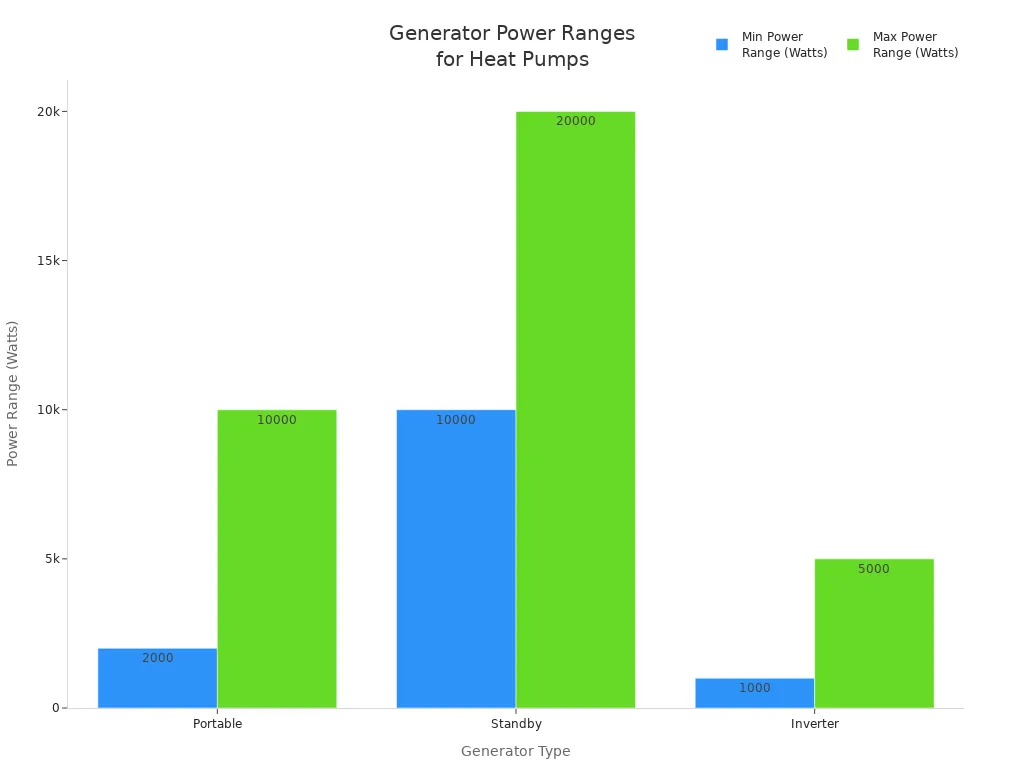
Standby generators make power that is safe for electronics. Portable generators cost less but need you to start them. Inverter generators are good for small things and electronics, but not for your whole house.
Diesel generators are great for running heat pumps. Diesel fuel lasts a long time in the tank. You save money on fuel during long blackouts. Diesel engines are strong and work well in tough places. You can keep diesel fuel at home for emergencies. Diesel generators let you use power even if the utility grid is down. If you live far away or have lots of storms, diesel power helps you. Some diesel engines use biodiesel or vegetable oil. This helps you use green energy. Diesel generators can use waste heat to warm water for your house.
Tip: Diesel generators are a good choice if you want backup power for heat pumps and big appliances.
UNIV Diesel Generators have features that make them a good pick for your home. They start and stop by themselves, so you do not need to do anything. UNIV generators can handle both running and starting loads. Your heat pump starts easily every time. Their engines use fuel well, so you save money. UNIV generators are strong and last a long time. They make clean power that keeps your electronics safe. You can put a UNIV generator outside your house. It connects to your fuel and turns on when the power goes out. UNIV has different sizes, so you can choose what fits your home.
Starts and stops automatically for easy backup
High power for your whole house
Uses fuel well to save money
Works well in hard weather
Makes clean power for electronics
If you want to feel safe during blackouts, a UNIV home standby generator is a smart choice.
Many people do not realize how much power a heat pump needs to start. They might only look at the running wattage and think that is enough. But heat pumps need a lot more power when they first turn on. The compressor and fan motors use extra electricity for a few seconds at startup. If you forget about this, your generator might not start the heat pump or could shut off.
Always check both running and starting wattage from the manufacturer. Only using running wattage can make your generator too small and your backup power unreliable.
Here are mistakes people make with startup power:
Using only running wattage in their math
Not counting the surge or peak wattage from the manufacturer
Thinking all appliances start without needing extra power
Forgetting that cold weather can make startup power higher
If you do not include startup power, your equipment can get damaged and you might lose heat during a power outage.
Some people only think about the heat pump when picking a generator. This is a common mistake. Your house has other important things that need power during an outage. If you forget about these, your generator might not give enough electricity. This can overload your system and make your backup power stop working.
Not adding up the total wattage for all appliances
Not thinking about surge power for things like fridges and pumps
Forgetting about all the power your house uses, especially in cold weather or emergencies
If you ignore other loads, you can have problems like:
Not enough power for your house
Generator damage from too much load
Heat pump and other things may not work in a blackout
Tip: Write down all the appliances you want to use and add up their wattages. This helps you avoid problems and keeps your house comfortable.
Some people think a bigger generator is always better. But picking a generator that is too big can waste your money. A large generator costs more to buy and uses more fuel. Big generators do not run as well if you do not use all their power. This makes them cost more to use and fix.
Choosing a generator that fits your real power needs saves money. You get good backup power without wasting energy. Always use real numbers and check your appliances before you choose.
Note: The best generator size is one that fits your needs with a little extra, not one that is much bigger than you need.
Many people try to pick and set up a generator without asking an expert. They think they can do the math or listen to friends. This can lead to mistakes that cost money and put your home in danger. If you skip talking to a trained electrician or HVAC technician, you miss out on important advice and safety tips.
A professional knows how much power your home really needs. They check your electrical panel, appliances, and heat pump. They do not guess or use rough numbers. Instead, they do careful load calculations for your house. This helps you choose a generator that fits and stops overloads.
You should find a technician who knows about whole-home backup power. The right expert understands big appliances like central air conditioning and electric water heaters. They also know about medical equipment and old wiring. Safety and following rules are important, especially if your home is special.
Here are things to look for when you pick a professional:
Experience with sizing and installing standby generators
Skill in checking power needs for all appliances
Knowledge of safety codes and local rules
Ability to put in transfer switches for safe use
Expertise in wiring and testing before you use the system
A good electrician can figure out the wattage for every device you want to run. They make sure your generator setup follows local laws and keeps your warranty safe. Experts also check your site, install transfer switches, and connect wires and fuel. They test everything to make sure it works before you need it.
Tip: Getting a pro to install your generator keeps it safe and working well. You avoid dangers like backfeeding, which can hurt workers and break your equipment.
If you try to size or set up a generator alone, you might pick the wrong size, wire it wrong, or skip safety steps. These mistakes can cause power loss, damage, or even fires. You could also break local rules and lose your warranty.
When you hire a pro, you feel calm. Your generator will work during outages. Your heat pump and other devices will stay safe. You will not worry about hidden problems or expensive fixes. Always ask a trained electrician or HVAC technician before you buy or set up a generator for your heat pump. This keeps your home safe and your backup power strong.
You need to check the voltage and phase before you buy a generator for your heat pump. Most homes use single-phase power. Heat pumps and generators for homes usually match this setup. If you pick the wrong voltage or phase, your equipment may not work or could get damaged.
Residential air-source heat pumps usually need 240 volts and a dedicated circuit.
Amperage for heat pumps ranges from 20 to 50 amps, depending on the size.
Ductless mini-split systems often use 230-240 volts, but smaller units may use 110/120 volts.
Mini-split systems can draw between 15 and 45 amps, especially if you have more than one zone.
Every heat pump and mini-split system needs its own dedicated electrical circuit.
You should always match the generator’s voltage and phase to your heat pump’s requirements. If you are not sure, check the nameplate on your heat pump or ask a professional. This step helps you find the right generator and keeps your system safe.
You want a generator that can run as long as you need it. Heat pumps work best when they run steadily. Turning them on and off makes them work harder and can create more noise. A generator with a long run time lets your heat pump operate smoothly. This helps your home stay comfortable and quiet.
Noise matters, too. Some generators make a lot of noise, which can bother you and your neighbors. Newer heat pumps run quietly, and you want a generator that matches this low noise level. Look for models with sound-reducing features or enclosures. Some places have rules about how loud a generator can be, especially at night. Always check local noise limits before you buy.
Tip: Choose a generator that runs quietly and can operate for many hours without refueling. This makes life easier during long outages.
You can use online calculators to estimate your power needs, but talking to a professional gives you the best results. Electricians and HVAC experts know how to measure your home’s power use. They can help you pick a generator that matches your needs and follows safety rules.
A professional will:
Check your heat pump’s voltage, phase, and amperage.
Add up all your essential loads.
Make sure your generator can handle starting surges.
Install your system safely and test it before you need it.
If you want to find the right generator, do not guess. Use real numbers and get expert advice. This way, you protect your home and make sure your backup power works when you need it most.
Picking the right generator size for your heat pump helps keep your home safe and cozy. You need to:
Figure out how much power your heat pump uses when running and starting.
Add up all the important things in your house that need power.
Leave some extra power for safety.
UNIV Diesel Generators give strong and steady backup power. If you are not sure what to do, try a sizing calculator or ask an electrician for help.
For expert advice, contact UNIV. This way, you can pick the best generator for your home.
Your generator may overload and shut down. Your heat pump might not start or could stop working. This can damage both your generator and your heat pump.
Yes, you can run other appliances. You must add up the wattage for all devices. Make sure your generator can handle the total power needed, including starting surges.
Check the nameplate on your heat pump. Look for "LRA" (Locked Rotor Amps) and multiply by the voltage. You can also find this information in the user manual or manufacturer’s specs.
You should hire a licensed electrician or HVAC technician. They will make sure your system is safe and follows local codes. This helps protect your home and equipment.
Most portable generators do not have enough power for a whole-house heat pump. You usually need a standby or large diesel generator for this job.
A safety margin is extra wattage above your total needs. It helps your generator handle power surges and keeps it from running at full capacity all the time. This extends the life of your generator.
You should check your generator every month. Change the oil and filters as the manufacturer recommends. Regular maintenance keeps your generator ready for emergencies.
Tip: Always test your generator before storm season. This ensures it works when you need it most.


